Stromata Editions
The Shepherd of Hermas — The First Vision
Vis. 1.1.1–1.4.3
Complete audiobook →Chapter 1
Greek source
Ὁ θρέψας με πέπρακέν με Ῥόδῃ τινὶ εἰς Ῥώμην· μετὰ πολλὰ ἔτη ταύτην ἀνεγνωρισάμην καὶ ἠρξάμην αὐτὴν ἀγαπᾶν ὡς ἀδελφήν.
Translation
The man who had raised me sold me to a woman named Rhoda in Rome. Many years later I recognized her again and began to love her as a sister.
Greek source
μετὰ χρόνον τινὰ λουομένην εἰς τὸν ποταμὸν τὸν Τίβεριν εἶδον καὶ ἐπέδωκα αὐτῇ τὴν χεῖρα καὶ ἐξήγαγον αὐτὴν ἐκ τοῦ ποταμοῦ. ταύτης οὖν ἰδὼν τὸ κάλλος διελογιζόμην ἐν τῇ καρδίᾳ μου λέγων· Μακάριος ἤμην εἰ τοιαύτην γυναῖκα εἶχον καὶ τῷ κάλλει καὶ τῷ τρόπῳ. μόνον τοῦτο ἐβουλευσάμην, ἕτερον δὲ οὐδέν.
Translation
Some time later I saw her bathing in the river Tiber. I gave her my hand and brought her out of the river. Seeing her beauty, I thought in my heart, “I would be happy if I had a wife like her, in beauty and in character.” This was all I thought of, and nothing else.
Greek source
μετὰ χρόνον τινὰ πορευομένου μου εἰς Κούμας καὶ δοξάζοντος τὰς κτίσεις τοῦ θεοῦ, ὡς μεγάλαι καὶ ἐκπρεπεῖς καὶ δυναταί εἰσιν, περιπατῶν ἀφύπνωσα. καὶ πνεῦμά με ἔλαβεν καὶ ἀπήνεγκέν με δι’ ἀνοδίας τινός, δι’ ἧς ἄνθρωπος οὐκ ἐδύνατο ὁδεῦσαι· ἦν δὲ ὁ τόπος κρημνώδης καὶ ἀπερρηγὼς ἀπὸ τῶν ὑδάτων. διαβὰς οὖν τὸν ποταμὸν ἐκεῖνον ἦλθον εἰς τὰ ὁμαλά, καὶ τιθῶ τὰ γόνατα καὶ ἠρξάμην προσεύχεσθαι τῷ κυρίῳ καὶ ἐξομολογεῖσθαί μου τὰς ἁμαρτίας.
Translation
Some time later, as I was travelling to Cumae and praising God's creations for their greatness, splendour, and power, I fell asleep while walking. A spirit took hold of me and carried me through a trackless place where no person could walk. The place was steep and cut off from the waters. After crossing that river, I reached level ground, knelt down, and began to pray to the Lord and confess my sins.
Greek source
προσευχομένου δέ μου ἠνοίγη ὁ οὐρανός, καὶ βλέπω τὴν γυναῖκα ἐκείνην ἣν ἐπεθύμησα ἀσπαζομένην με ἐκ τοῦ οὐρανοῦ, λέγουσαν· Ἑρμᾶ, χαῖρε.
Translation
As I prayed, heaven opened, and I saw the woman whom I had desired greeting me from heaven and saying, “Greetings, Hermas.”
Greek source
βλέψας δὲ εἰς αὐτὴν λέγω αὐτῇ· Κυρία, τί σὺ ὧδε ποιεῖς; ἡ δὲ ἀπεκρίθη μοι·
Translation
I looked up at her and said, “Lady, what are you doing here?” She answered me:
Greek source
Ἀνελήμφθην ἵνα σου τὰς ἁμαρτίας ἐλέγξω πρὸς τὸν κύριον. λέγω αὐτῇ· Νῦν σύ μου ἔλεγχος εἶ; Οὔ, φησίν, ἀλλὰ ἄκουσον τὰ ῥήματα ἅ σοι μέλλω λέγειν. ὁ θεὸς ὁ ἐν τοῖς οὐρανοῖς κατοικῶν καὶ κτίσας ἐκ τοῦ μὴ ὄντος τὰ ὄντα καὶ πληθύνας καὶ αὐξήσας ἕνεκεν τῆς ἁγίας ἐκκλησίας αὐτοῦ ὀργίζεταί σοι ὅτι ἥμαρτες εἰς ἐμέ.
Translation
“I was taken up so that I might expose your sins before the Lord.” I said to her, “Are you my accuser now?” “No,” she said, “but listen to the words I am about to say to you. God, who dwells in the heavens, who brought what exists into being from what did not exist, and made it multiply and grow for the sake of his holy assembly, is angry with you because you sinned against me.”
Greek source
ἀποκριθεὶς αὐτῇ λέγω· Εἰς σὲ ἥμαρτον; ποίῳ τρόπῳ; ἢ πότε σοι αἰσχρὸν ῥῆμα ἐλάλησα; οὐ πάντοτέ σε ὡς θεὰν ἡγησάμην; οὐ πάντοτέ σε ἐνετράπην ὡς ἀδελφήν; τί μου καταψεύδῃ, ὦ γύναι, τὰ πονηρὰ ταῦτα καὶ ἀκάθαρτα;
Translation
I answered her, “Have I sinned against you? How? Or when have I spoken a shameful word to you? Have I not always regarded you as a goddess? Have I not always treated you with respect as a sister? Why do you falsely accuse me, woman, of these wicked and impure things?”
Greek source
γελάσασά μοι λέγει· Ἐπὶ τὴν καρδίαν σου ἀνέβη ἡ ἐπιθυμία τῆς πονηρίας. ἢ οὐ δοκεῖ σοι ἀνδρὶ δικαίῳ πονηρὸν πρᾶγμα εἶναι ἐὰν ἀναβῇ αὐτοῦ ἐπὶ τὴν καρδίαν ἡ πονηρὰ ἐπιθυμία; ἁμαρτία γέ ἐστιν καὶ μεγάλη, φησίν. ὁ γὰρ δίκαιος ἀνὴρ δίκαια βουλεύεται. ἐν τῷ οὖν δίκαια βουλεύεσθαι αὐτὸν κατορθοῦται ἡ δόξα αὐτοῦ ἐν τοῖς οὐρανοῖς καὶ εὐκατάλλακτον ἔχει τὸν κύριον ἐν παντὶ πράγματι αὐτοῦ. οἱ δὲ πονηρὰ βουλευόμενοι ἐν ταῖς καρδίαις αὐτῶν θάνατον καὶ αἰχμαλωτισμὸν ἑαυτοῖς ἐπισπῶνται, μάλιστα οἱ τὸν αἰῶνα τοῦτον περιποιούμενοι καὶ γαυριῶντες ἐν τῷ πλούτῳ αὐτῶν καὶ μὴ ἀντεχόμενοι τῶν ἀγαθῶν τῶν μελλόντων.
Translation
She laughed and said to me, “A wicked desire arose in your heart. Or do you not think it is a wicked thing for a righteous man if a wicked desire rises in his heart? It is indeed a sin, and a great one,” she said. “For the righteous man plans what is right. By planning what is right, he establishes his glory in heaven, and the Lord is ready to be reconciled with him in all his affairs. But those who plan wicked things in their hearts bring death and captivity upon themselves, especially those who seek to keep this present age for themselves, boast of their wealth, and do not hold fast to the good things that are to come.
Greek source
μετανοήσουσιν αἱ ψυχαὶ αὐτῶν, οἵτινες οὐκ ἔχουσιν ἐλπίδα, ἀλλὰ ἑαυτοὺς ἀπεγνώκασιν καὶ τὴν ζωὴν αὐτῶν. ἀλλὰ σὺ προσεύχου πρὸς τὸν θεόν, καὶ ἰάσεται τὰ ἁμαρτήματά σου καὶ ὅλου τοῦ οἴκου σου καὶ πάντων τῶν ἁγίων.
Translation
“The souls of those who have no hope, who have given up on themselves and their lives, will repent. But you, pray to God, and he will heal your sins and those of your whole household and of all the holy ones.”
Chapter 2
Greek source
Μετὰ τὸ λαλῆσαι αὐτὴν τὰ ῥήματα ταῦτα ἐκλείσθησαν οἱ οὐρανοί· κἀγὼ ὅλος ἤμην πεφρικὼς καὶ λυπούμενος. ἔλεγον δὲ ἐν ἐμαυτῷ· Εἰ αὕτη μοι ἡ ἁμαρτία ἀναγράφεται, πῶς δυνήσομαι σωθῆναι; ἢ πῶς ἐξιλάσομαι τὸν θεὸν περὶ τῶν ἁμαρτιῶν μου τῶν τελείων; ἢ ποίοις ῥήμασιν ἐρωτήσω τὸν κύριον ἵνα ἱλατεύσηταί μοι;
Translation
After she had spoken these words, the heavens closed. I was overcome with fear and grief. I said to myself, “If this sin is entered against me, how can I be saved? How can I make atonement to God for my fully committed sins? What words can I use to ask the Lord to be gracious to me?”
Greek source
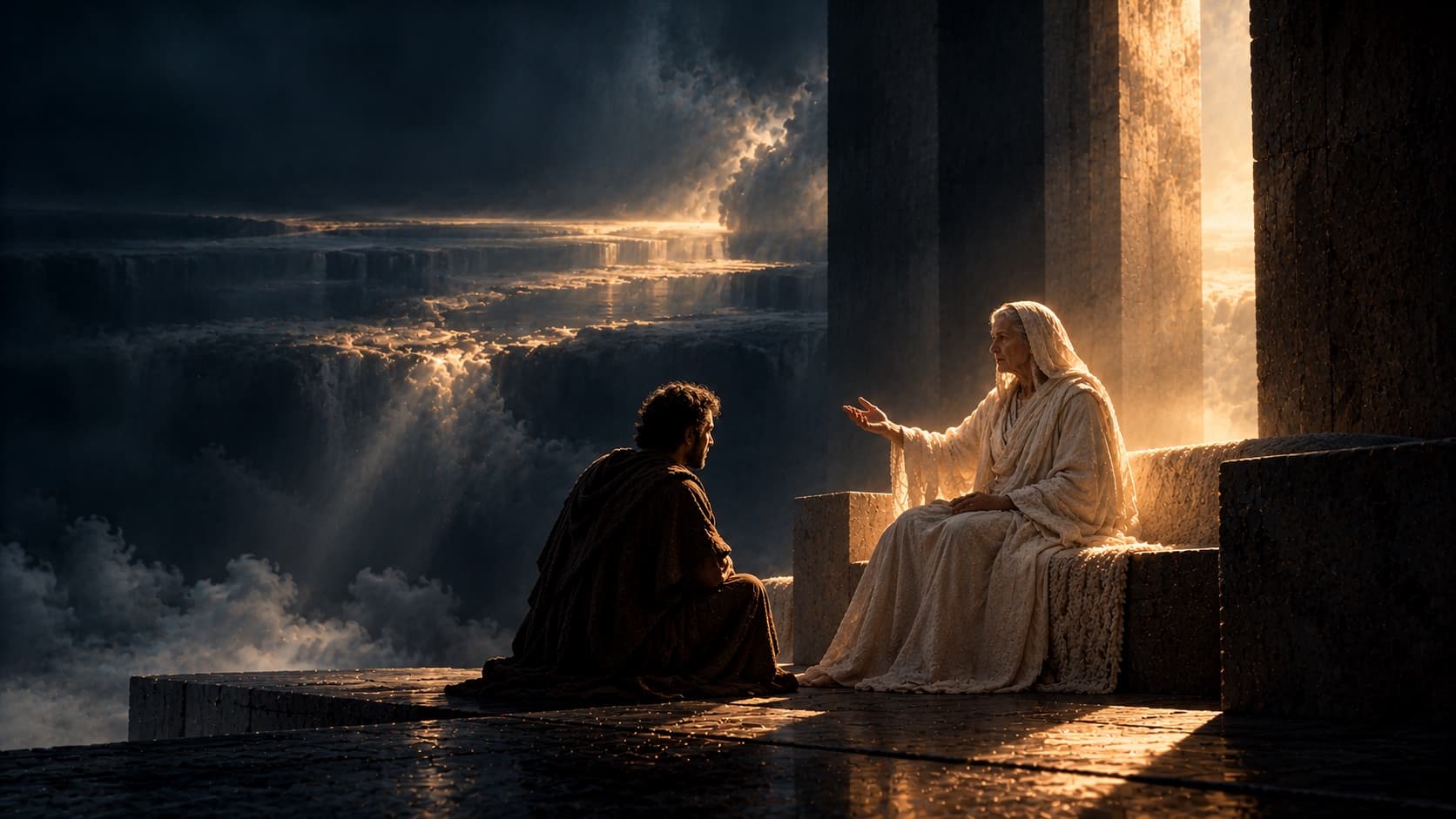
ταῦτά μου συμβουλευομένου καὶ διακρίνοντος ἐν τῇ καρδίᾳ μου βλέπω κατέναντί μου καθέδραν λευκὴν ἐξ ἐρίων χιονίνων γεγονυῖαν μεγάλην· καὶ ἦλθεν γυνὴ πρεσβῦτις ἐν ἱματισμῷ λαμπροτάτῳ, ἔχουσα βιβλίον εἰς τὰς χεῖρας, καὶ ἐκάθισεν μόνη καὶ ἀσπάζεταί με· Ἑρμᾶ, χαῖρε.
Translation
While I was considering these things and doubting in my heart, I saw before me a large white seat made of snow-white wool. An elderly woman came in a very splendid garment, holding a book in her hands. She sat down alone and greeted me: “Greetings, Hermas.”
Greek source
κἀγὼ λυπούμενος καὶ κλαίων εἶπον· Κυρία, χαῖρε. καὶ εἶπέν μοι· Τί στυγνός, Ἑρμᾶ; ὁ μακρόθυμος, ὁ ἀστομάχητος, ὁ πάντοτε γελῶν, τί οὕτως κατηφὴς τῇ ἰδέᾳ καὶ οὐχ ἱλαρός; κἀγὼ εἶπον αὐτῇ· Ὑπὸ γυναικὸς ἀγαθωτάτης λεγούσης μοι ὅτι ἥμαρτον εἰς αὐτήν.
Translation
Grieving and weeping, I said, “Greetings, lady.” She said to me, “Why are you so downcast, Hermas? You who are patient, who are not quick to anger, who are always laughing—why does your face look so gloomy and not cheerful?” I said to her, “Because a very good woman told me that I had sinned against her.”
Greek source
ἡ δὲ ἔφη· Μηδαμῶς ἐπὶ τὸν δοῦλον τοῦ θεοῦ τὸ πρᾶγμα τοῦτο. ἀλλὰ πάντως ἐπὶ τὴν καρδίαν σου ἀνέβη περὶ αὐτῆς. ἔστιν μὲν τοῖς δούλοις τοῦ θεοῦ ἡ τοιαύτη βουλὴ ἁμαρτίαν ἐπιφέρουσα· πονηρὰ γὰρ βουλὴ καὶ ἔκπληκτος εἰς πάνσεμνον πνεῦμα καὶ ἤδη δεδοκιμασμένον, ἐὰν ἐπιθυμήσῃ πονηρὸν ἔργον, καὶ μάλιστα Ἑρμᾶς ὁ ἐγκρατής, ὁ ἀπεχόμενος πάσης ἐπιθυμίας πονηρᾶς καὶ πλήρης πάσης ἁπλότητος καὶ ἀκακίας μεγάλης.
Translation
She said, “May such a thing never befall a servant of God. Yet the thought about her certainly rose in your heart. For servants of God, a thought of this kind brings sin. It is a wicked and startling thought for a wholly reverent spirit, already put to the test, to desire a wicked deed—especially for Hermas, who has self-control, abstains from every wicked desire, and is full of simplicity and great innocence.”
Chapter 3
Greek source
Ἀλλ’ οὐχ ἕνεκα τούτου σοι ὀργίζεται ὁ θεός, ἀλλ’ ἵνα τὸν οἶκόν σου τὸν ἀνομήσαντα εἰς τὸν κύριον καὶ εἰς ὑμᾶς τοὺς γονεῖς αὐτῶν ἐπιστρέψῃς. ἀλλὰ φιλότεκνος ὢν οὐκ ἐνουθέτεις σου τὸν οἶκον, ἀλλὰ ἀφῆκες αὐτὸν καταφθαρῆναι· διὰ τοῦτο ὀργίζεταί σοι ὁ κύριος· ἀλλὰ ἰάσεταί σου πάντα τὰ προγεγονότα πονηρὰ ἐν τῷ οἴκῳ σου· διὰ γὰρ τὰς ἐκείνων ἁμαρτίας καὶ ἀνομήματα σὺ κατεφθάρης ἀπὸ τῶν βιωτικῶν πράξεων.
Translation
“But God is angry with you not because of this, but so that you may turn back your household, who have acted lawlessly against the Lord and against you, their parents. Yet because you love your children, you did not admonish your household but let them become corrupt. That is why the Lord is angry with you. But he will heal all the evil that has already happened in your household. For because of their sins and lawless deeds, you have been corrupted by worldly affairs.
Greek source
ἀλλ’ ἡ πολυσπλαγχνία τοῦ κυρίου ἠλέησέν σε καὶ τὸν οἶκόν σου καὶ ἰσχυροποιήσει σε καὶ θεμελιώσει σε ἐν τῇ δόξῃ αὐτοῦ. σὺ μόνον μὴ ῥαθυμήσῃς, ἀλλὰ εὐψύχει καὶ ἰσχυροποίει σου τὸν οἶκον. ὡς γὰρ ὁ χαλκεὺς σφυροκοπῶν τὸ ἔργον αὐτοῦ περιγίνεται τοῦ πράγματος οὗ θέλει, οὕτω καὶ ὁ λόγος ὁ καθημερινὸς ὁ δίκαιος περιγίνεται πάσης πονηρίας. μὴ διαλίπῃς οὖν νουθετῶν σου τὰ τέκνα· οἶδα γὰρ ὅτι ἐὰν μετανοήσουσιν ἐξ ὅλης καρδίας αὐτῶν, ἐνγραφήσονται εἰς τὰς βίβλους τῆς ζωῆς μετὰ τῶν ἁγίων.
Translation
“But the Lord's great compassion has shown mercy to you and your household. He will strengthen you and establish you in his glory. Only do not grow careless; take courage and strengthen your household. For just as a smith, by hammering his work, masters the thing he wants to make, so too righteous words spoken day by day overcome every wickedness. Do not cease admonishing your children. I know that if they repent with all their heart, they will be inscribed in the books of life with the holy ones.”
Greek source
μετὰ τὸ παῆναι αὐτῆς τὰ ῥήματα ταῦτα λέγει μοι· Θέλεις ἀκοῦσαί μου ἀναγινωσκούσης; λέγω κἀγώ· Θέλω, κυρία. λέγει μοι· Γενοῦ ἀκροατὴς καὶ ἄκουε τὰς δόξας τοῦ θεοῦ. ἤκουσα μεγάλως καὶ θαυμαστῶς ὃ οὐκ ἴσχυσα μνημονεῦσαι· πάντα γὰρ τὰ ῥήματα ἔκφρικτα, ἃ οὐ δύναται ἄνθρωπος βαστάσαι. τὰ οὖν ἔσχατα ῥήματα ἐμνημόνευσα·
Translation
Once her words had ended, she said to me, “Do you want to hear me read?” I said, “I do, lady.” She said to me, “Listen carefully and hear the glories of God.” What I heard was grand and wondrous, but I could not remember it. Every word was terrifying, more than a person can bear. I did remember the last words, however,
Greek source
ἦν γὰρ ἡμῖν σύμφορα καὶ ἥμερα· Ἰδοὺ ὁ θεὸς τῶν δυνάμεων, ὁ ἀοράτῳ δυνάμει καὶ κραταιᾷ καὶ τῇ μεγάλῃ συνέσει αὐτοῦ κτίσας τὸν κόσμον καὶ τῇ ἐνδόξῳ βουλῇ περιθεὶς τὴν εὐπρέπειαν τῇ κτίσει αὐτοῦ, καὶ τῷ ἰσχυρῷ ῥήματι πήξας τὸν οὐρανὸν καὶ θεμελιώσας τὴν γῆν ἐπὶ ὑδάτων καὶ τῇ ἰδίᾳ σοφίᾳ καὶ προνοίᾳ κτίσας τὴν ἁγίαν ἐκκλησίαν αὐτοῦ, ἣν καὶ ηὐλόγησεν, ἰδοὺ μεθιστάνει τοὺς οὐρανοὺς καὶ τὰ ὄρη καὶ τοὺς βουνοὺς καὶ τὰς θαλάσσας, καὶ πάντα ὁμαλὰ γίνεται τοῖς ἐκλεκτοῖς αὐτοῦ, ἵνα ἀποδοῖ αὐτοῖς τὴν ἐπαγγελίαν, ἣν ἐπηγγείλατο, μετὰ πολλῆς δόξης καὶ χαρᾶς, ἐὰν τηρήσωσιν τὰ νόμιμα τοῦ θεοῦ ἃ παρέλαβον ἐν μεγάλῃ πίστει.
Translation
for they were beneficial to us and gentle:
“Look at the God of the powers. By his invisible and mighty power and his great understanding he created the world; by his glorious counsel he clothed his creation with beauty. By his powerful word he fixed heaven in place and founded the earth upon the waters. By his own wisdom and providence he created his holy assembly, which he also blessed. Look: he moves the heavens, the mountains, the hills, and the seas. Everything becomes level for his chosen ones, so that he may give them what he promised, with great glory and joy, if they keep the ordinances of God that they received in great faith.”
Chapter 4
Greek source
Ὅτε οὖν ἐτέλεσεν ἀναγινώσκουσα καὶ ἠγέρθη ἀπὸ τῆς καθέδρας, ἦλθαν τέσσαρες νεανίαι καὶ ἦραν τὴν καθέδραν καὶ ἀπῆλθον πρὸς τὴν ἀνατολήν.
Translation
When she had finished reading and risen from the seat, four young men came, lifted the seat, and went away toward the east.
Greek source
προσκαλεῖται δέ με καὶ ἥψατο τοῦ στήθους μου καὶ λέγει μοι· Ἤρεσέν σοι ἡ ἀνάγνωσίς μου; καὶ λέγω αὐτῇ· Κυρία, ταῦτά μοι τὰ ἔσχατα ἀρέσκει, τὰ δὲ πρότερα χαλεπὰ καὶ σκληρά. ἡ δὲ ἔφη μοι λέγουσα· Ταῦτα τὰ ἔσχατα τοῖς δικαίοις, τὰ δὲ πρῶτα τοῖς ἔθνεσιν καὶ τοῖς ἀποστάταις.
Translation
She called me over, touched my chest, and said to me, “Did you like my reading?” I said to her, “Lady, these last words please me, but the earlier ones are harsh and severe.” She said to me, “These last words are for the righteous, but the first are for the nations and for the apostates.”
Greek source
λαλούσης αὐτῆς μετ’ ἐμοῦ δύο τινὲς ἄνδρες ἐφάνησαν καὶ ἦραν αὐτὴν τῶν ἀγκώνων καὶ ἀπῆλθαν, ὅπου καὶ ἡ καθέδρα, πρὸς τὴν ἀνατολήν. ἱλαρὰ δὲ ἀπῆλθεν καὶ ὑπάγουσα λέγει μοι· Ἀνδρίζου, Ἑρμᾶ.
Translation
While she was speaking with me, two men appeared, took her by the arms, and went away to where the seat had gone, toward the east. She departed cheerfully, and as she went she said to me, “Be courageous, Hermas.”
Reader’s notes
1. 1.1.1 — The narrator Hermas is sold to Rhoda; she is the buyer. The Vulgata instead has a girl being sold: these are different source readings, not two translations of one Greek sentence (Whittaker 1967, p. 1; Tornau–Cecconi 2014, p. 39). The narrator’s account does not establish the historical author’s biography.
2. 1.1.3 — “A spirit” leaves the identity of
πνεῦμαunspecified. The account says that Hermas fell asleep while walking; its unusual sequence is retained.3. 1.1.6 — “Expose your sins before the Lord” retains the accusatory force of
ἐλέγξω, stronger than merely reporting or presenting them. Hermas consequently asks whether Rhoda is his accuser; her “No” is preserved without explaining away the tension.4. 1.1.7 — “As a goddess” renders
ὡς θεάν; it is not replaced with a more conventionally Christian expression of respect.5. 1.1.8–9 —
μετανοήσουσινmay denote repentance or regret. “Will repent” retains the source's formulation provisionally; this does not add an explanation of how hopeless people recover hope. The relationship between these sentences remains an open interpretative question.6. 1.2.1 — “Fully committed sins” distinguishes
ἁμαρτίαι ... τέλειαιfrom the inward thought that has just alarmed Hermas. The precise force of “complete” remains open.7. 1.2.3 — The pilot's “who never take offence” was too absolute and too specifically about reacting to an affront. The adjective
ἀστομάχητος, next to “patient,” describes freedom from anger or an uncontentious disposition. The new “who are not quick to anger” allows this range. “Who bear no ill will” would emphasize resentment; “who are not quarrelsome” would emphasize outward conflict. Neither is automatically wrong, but neither is as broad in this context. After the Greek was reconsidered, Lake and Lightfoot were checked at this locus: both use “good-tempered.” This supports a disposition reading rather than a claim that Hermas never perceives an offence. The LSJ search entry gives “without anger”; the full dictionary page was not successfully retrieved.8. 1.2.4 — The opening is a strong rejection or wish that such a thing should not befall God's servant, followed by acknowledgment of the thought.
ἔκπληκτος, rendered “startling,” and the relation of the tested spirit to the desire for a deed remain difficult. The text has not been rewritten as a modern account of intrusive thoughts.9. 1.3.1 — The plural “you, their parents” occurs within the address to Hermas. “Corrupted by worldly affairs” avoids treating
κατεφθάρηςas a definite statement of financial bankruptcy.10. 1.3.3 — The source reads
παῆναι. “Once her words had ended” follows a late passive aorist infinitive of παύω. Whittaker p. 4:2 and its apparatus were read: variant παυθῆναι A supports the cessation sense. The chosen spelling has not been replaced byπαῦσαι. “Glories of God” is plural.11. 1.3.3–4 — The sentence about remembering the last words and their being beneficial and gentle belongs to the narrator. Only the paragraph beginning “Look at the God of the powers” is the quoted reading. The source's hymn has been divided into sentences without changing its sequence, agency, cosmological images, or final condition. Whittaker p. 4:8 and the apparatus were read; the opening wording is an editorial reading, not unanimous manuscript testimony. Its “invisible and mighty power” is retained; the differently worded opening in Lake has not been imported.
12. 1.4.2 — The source distinguishes the last words “for the righteous” from the first “for the nations and for the apostates.” Both recipient groups are retained; Whittaker p. 4:18–21 and the apparatus were read; the variant wording for the nations does not justify dropping either group.
13. 1.4.3 —
Ἀνδρίζουis an imperative of courage expressed through a masculine idiom. “Be courageous” retains the exhortation without reproducing “play the man” as an English archaism.
About this edition
English translation v02. Greek source v01: Molly Whittaker, second revised edition, 1967; Patristic Text Archive (2018), Annette von Stockhausen — conversion to CTS-compliant PTA TEI and markup of places and persons. Technical derivative: Stromata Editions, 2026-09-29. Fixed version ef861ab3.
The translation is a reviewed working version following an AI editorial pass; human philological review is not claimed.
The reproduced Greek source and its technical derivative: CC BY-SA 4.0. Whitespace adapted for reading; words and diacritics preserved. Attribution does not imply endorsement of Stromata by PTA contributors.
← Hermas edition hub