
Stromata Editions · Voices of Early Christianity
Didache
Sixteen chapters on how a choice becomes a way, water, a common table and the expectation of the end.
Sixteen short chapters show a community in motion: learning how to live, baptise, pray, receive newcomers, test authority and remain watchful. Read the accurate translation, use the Greek parallel text, view the visual layer and open the research context.
Listen to the Didache in full
Audio edition
Complete audio edition
Not a monument behind glass, but a text that demands a response
How does conviction become daily practice — without confusing trust with naivety?
The Didache begins not with an abstract system but with a fork: two ways lie before a person. Moral choice then becomes bodily and communal — the water of baptism, the rhythm of fasting and prayer, a shared cup and bread. The text asks not only what a community believes, but how it receives a stranger, distinguishes service from exploitation, reconciles participants in the assembly and chooses those to whom it will entrust responsibility.
Quick facts
Nine points of orientation
01Extended manuscript title
“The Teaching of the Lord to the Nations through the Twelve Apostles.”
Qualification:The apostolic framing conveys authority but does not prove authorship by the Twelve.
02Author and place
The author is anonymous; the precise place of composition is unknown.
Qualification:Syria is often proposed but remains a hypothesis.
03Date
The final recoverable form is commonly dated to the late first or early second century.
Qualification:Individual traditions may be older; no precise year has been established.
04Language
The principal directly surviving text is transmitted in ancient Greek.
Qualification:No authorial copy survives.
05Extent of the edition
Sixteen chapters and 100 stable Segment IDs.
Qualification:Segment IDs are Stromata’s editorial addressing system, not ancient divisions.
06Principal Greek witness
An almost complete continuous text survives in manuscript H54, copied in 1056.
Qualification:This is a late copy, not the original work.
07Early Greek fragment
P.Oxy. 1782, from the end of the fourth century, preserves parts of the opening chapters.
Qualification:The fragment is small and does not replace the continuous witness.
08Structure
The two ways; water, fasting, prayer and meal; travellers and community order; the trial of the end.
Qualification:The four movements are a useful editorial map, not the only possible structure.
09Surviving ending
Segment `16.8` ends with a complete sentence.
Qualification:A lost continuation is possible, but its exact text and extent are unknown.
Reading map
Four movements
The editorial map helps reveal the text’s internal rhythm without presenting this structure as the only possible one.

1–6
Choose the way
The text opens with a fork between the way of life and the way of death. The choice quickly ceases to be an abstraction: it enters one’s relation to an enemy, the body, property, speech, a child, the poor and a teacher. The way of life requires more than avoiding murder or falsehood. It asks the reader to notice the early movements from which destruction grows. The way of death assembles the reverse image — a world in which another person becomes a means and force replaces truth. Chapter 6 concludes the movement with a sober measure: it is good to bear the whole instruction, but each person should do what they are able to bear. Moral height is joined not to a posture of faultlessness, but to direction and responsibility.
Central tension
Radical demand and an honest measure of strength.
Segment ID · 1.3 · 3.1 · 6.2
Start reading →
7–10
Enter a shared rhythm
After the instruction on the two ways, the text turns to the body and time of the community. Baptism requires water, the spoken name and preparation; when ideal conditions are unavailable, the rule offers successive alternatives. Fasting acquires its own weekly rhythm, prayer its repeated words, and the thanksgiving meal its cup, bread and image of what was scattered becoming one. These chapters do not offer a later, exhaustive liturgical system. They show how conviction takes the form of action and how practical flexibility coexists with a recognisable order. Flexibility does not mean randomness. At the centre is a community gathered by more than a shared idea: water, hunger, voice, thanksgiving and expectation of the kingdom bind it together.
Central tension
Established form and adaptation to real conditions.
Segment ID · 7.2–7.3 · 8.1–8.3 · 9.4
Start reading →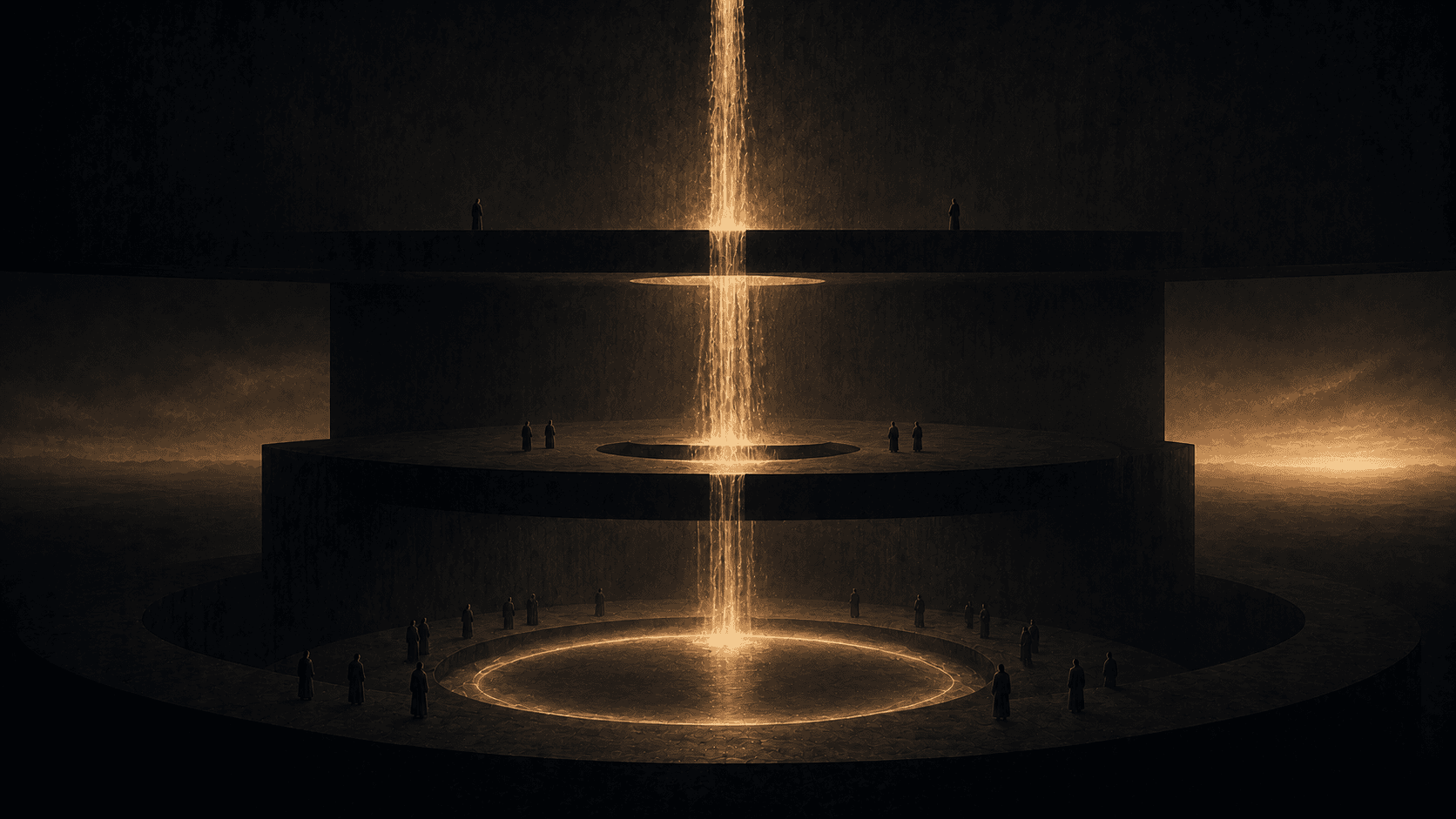
11–15
Test the guest and authority
Apostles, prophets, teachers and ordinary travellers visit the community. They are to be received, but hospitality does not mean abandoning discernment. Length of stay, attitude to money, willingness to work and correspondence between conduct and teaching become tests of authority. Local bishops and deacons appear beside itinerant ministers; the text does not explain this as the simple replacement of one system by another. Attention then returns to the common assembly: reconciliation, thanksgiving and the appointment of worthy ministers. The result is a fragile architecture of trust — open to gift but protected from exploitation. The most difficult lines of chapter 11 remind the reader that even a well-designed test does not remove every semantic uncertainty.
Central tension
Open hospitality and accountable authority.
Segment ID · 11.4–11.6 · 12.2–12.5 · 15.1–15.2
Start reading →
16
Endure before the end
The final movement contracts to one chapter and sharply expands the horizon. Everyday readiness — lamps, assemblies and care for souls — becomes preparation for a time of deception and trial. Love turns to hatred, the deceiver of the world appears, and the endurance of faith passes through a line whose meaning remains open. Three signs of truth, resurrection and the coming of the Lord follow. The surviving text ends with a complete sentence, although a lost continuation remains possible. Chapter 16 must therefore become neither a confident chronology of the end nor an artificially completed conclusion. The text leaves the reader before an open horizon. Its principal gesture is the call to remain watchful and bring the way to completion.
Central tension
The certainty of the summons and the irreducible openness of its details.
Segment ID · 16.2 · 16.5 · 16.6–16.8
Start reading →Research layer
Places where accuracy requires a pause
Six passages show where a translation must explain its choices and honestly preserve an open question.
Articles on the Didache

The Lord’s Prayer in the Didache: what a few words reveal
In this early Christian teaching text, the prayer takes up a single paragraph. Reading it closely reveals two different things: features of the Greek text and choices made by its translators.
Read the article
Apostles, prophets and impostors: how the Didache tests spiritual authority
Welcome a stranger as the Lord — then ask how long the visit will last. The Didache places these demands side by side, trying to preserve hospitality without leaving it open to exploitation.
Read the articleTransmission history
A text transmitted across a rupture in time
The Didache is an early work, but its principal continuous Greek witness is late: manuscript H54 was copied in 1056. A long gap separates the composition of the work from this copy. A small Greek fragment from the end of the fourth century confirms the early transmission of part of the opening chapters. Other traces survive in ancient translations, reworkings and related traditions — important, but not identical, forms of evidence.
Stromata’s editorial work begins by distinguishing them. Direct Greek text is not merged with a translation or a later adaptation; the probable is not presented as established; and a gap in manuscript history is not filled by an attractive guess. The history of transmission thus becomes part of the reading experience rather than small print after it.
- Early workperiod of composition
- Late fourth centurysmall Greek fragment
- H54 · 1056principal continuous witness
- Modern editiondistinguishing the witnesses
Stromata edition
Read, view and explore
Reader
Greek text and translation in synchronised reading, organised by chapter and stable Segment ID, with open translation decisions clearly marked.
AvailableListen
English audio edition of all sixteen chapters.
AvailableWatch on YouTube
Audio in English, German, Ukrainian and Russian. Choose your language in the player settings under “Audio track”.
Research Library
Textual history, semantic problems, parallels, translation comparison and stated limits of confidence with exact locators.
Research Library
Textual history, semantic problems, parallels, translation comparison and stated limits of confidence with exact locators.
Downloads
Approved editions and formats for reading, citation or offline use. Availability depends on rights and release readiness.
Methodology
How Stromata distinguishes text, translation, interpretation, hypothesis and reception — and how each consequential decision is reviewed.
Stromata Method
From witness to digital edition
- 1
Original
establish the Greek text and mark open readings.
- 2
Research
examine history, structure, semantic difficulties and reception.
- 3
Translation
communicate the text accurately without hiding ambiguity.
- 4
Review
verify segments, decisions, sources and versions.
- 5
Visual layer
connect each chapter with a restrained symbolic image.
- 6
Digital edition
combine reading, navigation and research depth.